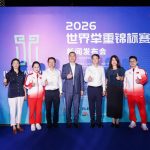
The International Weightlifting Federation -IWF- has officially presented the 2026 World Championships in Ningbo, where the competition will take place from 27 October to 8 November at the Ningbo Olympic Sports Center. The launch was held aboard a boat at the confluence of the city’s three rivers and brought together representatives of the Chinese Weightlifting Association, local authorities and Olympic champions Shi Zhiyong and Deng Wei. Organisers unveiled the ‘Lift Dreams in Ningbo’ slogan, logo, medals, trophy and mascot. The IWF expects athletes from nearly 120 countries and regions, although the final figure will depend on confirmed entries.
The presentation marks the beginning of the final preparations, but the significance of the championships extends beyond their visual identity. Ningbo will host the first qualification event for the Los Angeles 2028 Olympic Games, introduce the bodyweight categories in force since August to a senior World Championships and bring the IWF’s flagship competition back to China for the first time since Guangzhou 1995. The event will not directly award any Olympic places, but lifters competing in one of the 12 categories included at Los Angeles 2028 will be able to record the first of the five results required during the qualification process.
Qualification based on five results
The qualification period began on 27 July 2026 and will conclude on 7 May 2028. It is divided into two phases: athletes must record three valid totals during the first period and another two during the second. All five results used for the ranking must come from the same Olympic bodyweight category. Ningbo opens a calendar that also includes the 2027 and 2028 World Championships, the continental championships and five dedicated qualification events scheduled for Doha, Tashkent, Lima, Caracas and Chiang Rai. Qualification will depend on an athlete’s ranking position and completion of the required appearances across the two periods.
Los Angeles 2028 will feature 120 weightlifters, divided equally between 60 men and 60 women. Of the available places, 96 will be awarded through the Olympic qualification ranking and 12 will be reserved to ensure representation from the five continents. The United States will have six host-country quota places, while the remaining six will be allocated under the universality principle. The programme will expand from the 10 categories contested at Paris 2024 to 12, but the overall athlete quota will remain unchanged, meaning that the additional medal events will not be accompanied by an increase in the number of competitors.
Sixteen world titles, twelve Olympic events
The Ningbo World Championships will award medals across eight men’s categories —60kg, 65kg, 70kg, 75kg, 85kg, 95kg, 110kg and over 110kg— and eight women’s categories —49kg, 53kg, 57kg, 61kg, 69kg, 77kg, 86kg and over 86kg. However, the men’s 60kg and 70kg divisions and the women’s 49kg and 57kg divisions are not part of the Los Angeles programme. The other 12 correspond to the Olympic categories approved by the IWF and the International Olympic Committee -IOC-.
The choice of category will have direct consequences for some athletes. Those competing in Ningbo at men’s 60kg or 70kg, or women’s 49kg or 57kg, will be able to contest a world title but will subsequently have to move into an Olympic division if they want to enter the Los Angeles qualification ranking. The categories introduced in August replaced the men’s 71kg, 79kg, 88kg and 94kg divisions with 70kg, 75kg, 85kg and 95kg, while the women’s 48kg, 58kg and 63kg divisions became 49kg, 57kg and 61kg. The IWF has also established new World Standards for the snatch, clean and jerk and total in each category.
China regains the World Championships after 31 years
China last hosted the senior World Championships in Guangzhou in 1995. Ningbo will become the second Chinese city to stage the competition and will do so at the beginning of an Olympic cycle of particular importance to one of weightlifting’s leading historic powers. “China has a long and proud tradition of excellence in our sport,” said IWF President Mohammed Jalood, who believes that hosting the first qualification event can contribute to the discipline’s further development and promotion in the country. The national association is also chaired by Zhan Xugang, the Olympic champion at Atlanta 1996 and Sydney 2000.
The Ningbo Olympic Sports Center, built in 2019 with a capacity of approximately 10,000 spectators, hosted the Asian Championships in the same year. IWF technical visits have reviewed the venue, accommodation, transport, visa procedures, television production and services for teams and the media. The newly presented identity also incorporates local references: the logo combines the figure of a weightlifter with the Chinese character ‘ding’ and the confluence of Ningbo’s three rivers; the medals use the shape of a barbell and celadon motifs; and the mascot JunJun represents the mythical Xiezhi creature and contains elements of Hemudu culture. The organisers have therefore connected the beginning of the road to Los Angeles 2028 with the heritage of the city bringing the IWF’s leading championship back to China.
 Last related articles