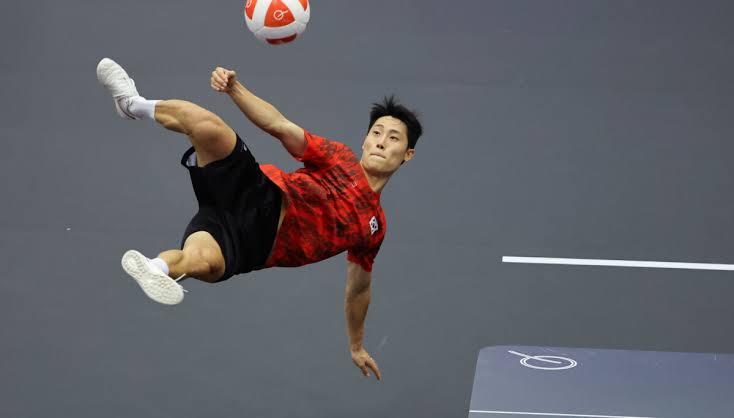
Teqball awarded its first Asian Games medals at Aichi-Nagoya 2026, where the programme included five events: men’s and women’s singles, men’s and women’s doubles, and mixed doubles. Thailand claimed three titles, while Myanmar and South Korea won the singles competitions. With medallists coming from different parts of the continent, the discipline delivered more than a championship: it demonstrated its ability to operate within a major multi-sport event.
The International Teqball Federation -FITEQ- views that experience as part of an institutional project whose immediate objective is to secure recognition from the International Olympic Committee -IOC-. “The global teqball community dreams of becoming an Olympic sport one day,” its secretary general, Laszlo Vajda, said during the competition. Founded in 2017, the federation has supported its expansion through World Championships, appearances at continental events and a promotional strategy involving former footballers such as Carles Puyol. Clubs including Barcelona, Manchester United and Paris Saint-Germain have also used teqball tables as training equipment, although that commercial visibility does not replace the institutional requirements imposed by the Olympic system.
Recognition remains pending
FITEQ submitted its initial recognition documents in February 2026. In July, the IOC granted the federation access to its recognition platform to continue the procedure and complete its application. According to FITEQ, the preliminary questionnaire received an encouraging response, although the IOC departments requested additional information and adjustments in several areas. Access to the platform confirms that a formal assessment is under way, but it does not mean that teqball or its international federation has already been recognised.
FITEQ does not yet appear on the IOC’s official list of recognised international federations. There is also no public record of a formal proposal to add the discipline to the Brisbane 2032 programme. These are two separate procedures: the federation must first demonstrate that it meets the conditions required to join the Olympic Movement and would then have to make the case for adding one or more events to the Games. Passing the first assessment would open that possibility, but would not automatically secure an Olympic place.
The federation under examination
The IOC does not assess only whether a discipline is attractive to spectators. Its review covers FITEQ’s statutes, electoral system, division of responsibilities and accountability mechanisms. It also examines the federation’s independence, transparency and integrity; athlete safeguarding; equality and inclusion; the stability of its international calendar; education programmes; and the economic and environmental sustainability of its competitions. FITEQ must also demonstrate that it applies the World Anti-Doping Code and the Olympic rules designed to prevent competition manipulation.
FITEQ says it has more than 150 national bodies, but the assessment must determine how many operate as active federations, which are recognised by their national sports authorities or Olympic committees, and what competitions, athletes and development programmes they maintain. The federation distinguishes in its own records between affiliated bodies and organisations with national recognition. Its status as a medal sport at the Kraków-Małopolska 2023 European Games and now at the Asian Games provides operational experience, while its inclusion by the Olympic Council of Asia -OCA- shows that a continental association can integrate it into a multi-sport programme. Neither precedent, however, replaces the individual verification of its national structures.
Brisbane requires a second process
Any eventual admission to the Olympic programme would require a second examination. Alongside its international reach, the IOC and the organising committee would need to assess athlete and official numbers, operating costs, venue requirements, competition formats, gender equality, youth appeal, audience potential, sustainability and compatibility with the Games’ overall participant limit. Teqball can use relatively small indoor venues and offers men’s, women’s and mixed events, characteristics that could support a compact proposal. It would nevertheless have to show that these advantages justify its inclusion ahead of other disciplines pursuing the same objective.
The process for Brisbane introduces an additional factor. The IOC has changed its approach to allow individual events or disciplines to be assessed, rather than deciding exclusively whether to admit or exclude an entire sport. The five-event programme used at Aichi-Nagoya gives FITEQ an existing reference, but not all five would necessarily have to form part of a future Olympic proposal. The federation might need to select a smaller format and demonstrate which events provide the strongest combination of gender balance, international reach and financial viability. This flexibility creates additional entry routes, but also allows the IOC to compare the proposals submitted by numerous interested federations more precisely.
The next step is to complete the detailed questionnaire, provide the additional documentation requested and respond to the observations made by the IOC’s different departments. FITEQ may need to amend its statutes, regulations or governance practices and demonstrate effective compliance with integrity, anti-doping and competition manipulation codes. If the assessment is successful, the IOC could grant the federation provisional or full recognition. Only then would a separate phase begin: selecting the events for a possible proposal, demonstrating their viability within the programme, securing the support of the Brisbane organising committee and obtaining IOC approval. No public timetable has been established for completing the recognition process, meaning that 2032 remains a strategic and promotional objective rather than an accepted bid or guaranteed Olympic appearance.
 Last related articles