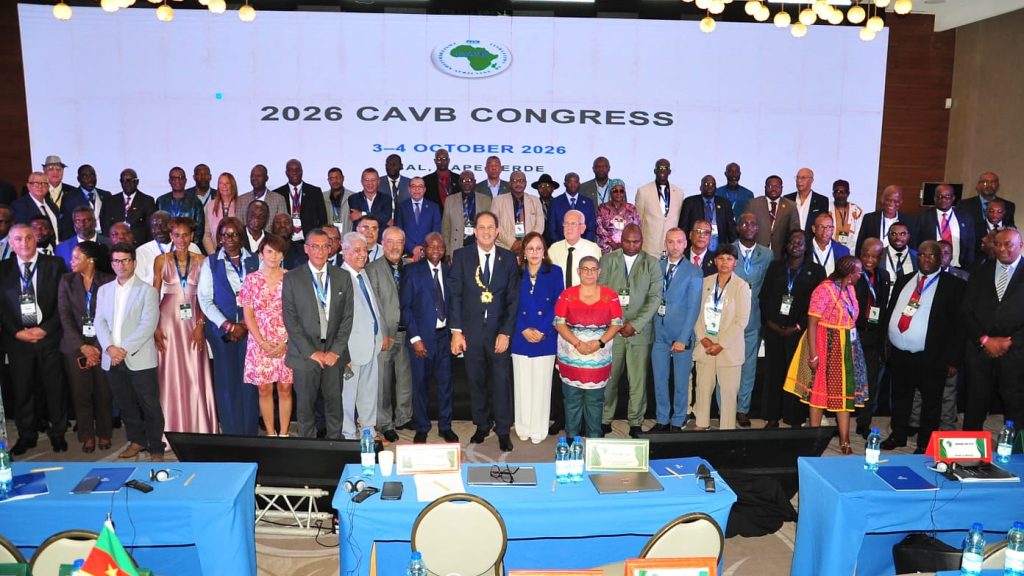
The African Volleyball Confederation -CAVB- brought together representatives of its 54 national federations on October 3–4 in Sal, Cape Verde, for a congress combining recognition of African sports leaders with planning for its next phase of activity. President Bouchra Hajij presented Mustapha Berraf, President of the Association of National Olympic Committees of Africa -ANOCA-, with the confederation’s highest distinction. The award recognised his commitment to developing sport across the continent and his support for initiatives led by African sports institutions.
The ceremony also honoured Habu Gumel, ANOCA Treasurer, for his contribution to the African sports movement and his support for CAVB activities, and Filomena Fortes, President of the Cape Verdean Olympic Committee, in recognition of her work in the host country. The tributes preceded discussions on the activity review, commission reports and priorities for 2027–2028. The agenda covered competition organisation, training, national federation resources and opportunities for younger generations.
More countries hosting African competitions
Hajij’s report identified the wider geographical distribution of competitions as one of the confederation’s achievements. According to the review, events have expanded to 11 host countries, broadening a calendar previously concentrated in a small group of nations, including Tunisia, Egypt and Morocco. The addition of hosts such as Rwanda and Nigeria enables more federations to participate in event delivery and develop technical and administrative experience. Training also featured in the review: the President reported 61 newly qualified international referees, comprising 30 in volleyball and 31 in beach volleyball.
That expansion coexists with constraints the President outlined during the congress: limited resources, inadequate facilities, travel costs and the need for funding and government support. The distinction between hosting a championship and sustaining activity throughout a season runs through the priorities presented in Sal. Federations need the resources to prepare their national teams, train staff and provide regular competition, alongside meeting the requirements of international events. At the close of the congress, Hajij identified the infrastructure shortage as the main obstacle and announced cooperation with the International Volleyball Federation -FIVB- to address those needs.
Youth and women’s participation
Youth participation was another area requiring attention in the presidential report, which acknowledged that fewer teams were taking part in youth competitions than in senior events. “Our greatest responsibility today concerns the next generation,” Hajij said. For the next two years, the President identified priorities including expanding youth competitions, improving training for national federations and raising athletes’ visibility. The Dakar 2026 Youth Olympic Games form part of that immediate agenda, particularly for beach volleyball development and opportunities for young African athletes.
In her closing assessment, Hajij also highlighted the approval of measures to increase women’s representation across the sport, from athletes to coaches, referees and administrators. “We need more women in sports leadership”, she told ‘Inforpress’. The announced direction covers both access to participation and representation in technical and leadership positions. The information released about the congress does not specify quotas, deadlines or mechanisms for implementing those measures.
Beach volleyball and support for federations
Delegates also agreed to give priority to beach volleyball, a decision Hajij linked to its lower investment requirements and the talent available across the continent. It continues an approach outlined by the relevant commission in March: developing more regular national and zonal competitions and promoting an African tour. Its less demanding facility requirements offer a route to wider participation, although coach and referee training, travel and a consistent competition calendar still require resources and coordination between federations.
The Development Commission report, presented by Fayzal Bundhun, described the tools planned to support and assess those programmes. In 2026, 26 competitions received support through ball donations, alongside training initiatives for coaches, referees and federation officials. The monitoring framework includes an electronic survey of national federations, six-monthly reports from CAVB’s seven zones and quarterly reviews by its governing bodies. The commission also submitted proposals to the congress to continue equipment donations, expand training and support the reopening of development centres in Africa.
 Last related articles