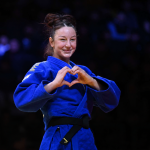
The retirement of Christa Deguchi brings the competitive career of one of recent judo’s most distinctive figures to a close, but it also leaves behind a story that stretches well beyond Olympic gold and her two world titles. Born on 29 October 1995 in Nagano, raised within Japan’s demanding judo system and later becoming a reference point for Canada, her journey cannot be understood through medals alone. It is also a story of identity, family, character and perseverance, all of which stayed with her to the very end.
The daughter of a Canadian father and a Japanese mother, Deguchi grew up between two heritages that would ultimately shape both her career and the way she moved through sport. Her father, a familiar presence on the international circuit as a photographer, and her mother accompanied her along a path that always carried a strong family dimension. So did her sister Kelly Deguchi, with whom she shared years of training, travel, qualification campaigns and the dream of reaching the Olympic stage together. “This was a shared journey,” the judoka said after winning gold in Paris. “In the Tokyo cycle I was alone, but having my sister here in this cycle, through this same process, meant I was not alone. Having both of us here was huge for our family. It’s good to share this crazy ride.”
Family, Kelly and a story built together
The family dimension appears again and again in the most important memories of her career. At the Paris Games, one of the things she valued most was being able to live that moment with her loved ones. “What made me happiest was being able to bring my family to the Olympic Games,” she said. Her grandmother, Kesako Deguchi, travelled to Europe for the first time to be with them, at the age of 85, having previously left Japan only twice to watch her granddaughters compete, in Doha and Abu Dhabi. “I am really happy to be able to travel, even at 85. It means a lot to me,” said her grandmother, who had been following Christa since she was three years old.
That importance of family also helps explain why her story with Kelly holds such a special place. It was not simply a relationship between sisters, but a shared sporting experience, with everything that means at a level as demanding as elite judo. Christa spoke about the difficulty of Kelly’s draw in Paris and how she responded to it: “At first she was shocked, but she found faith in herself and reacted really positively.” She then added a line that captures what that cycle meant for both of them: “Kelly had to win too to come here. Having my sister here meant I was not alone.” The family left Paris with two Olympians, one gold medal and a collection of memories impossible to measure.
Japan, Canada and the decision to make her way outside the system
The other major thread running through her life was identity. Raised in Japan and trained in one of the world’s most competitive judo systems, Deguchi understood early on that talent does not always guarantee space. In 2017, faced with limited international opportunities in Japan, she chose to represent Canada. The decision was neither immediate nor simple, but it was definitive. “I got tired of thinking about it. I was just like, ‘Yeah. Let’s just go for Canada,’” she recalled of that moment, which arrived almost suddenly during a bike ride to training. In time, she came to see it clearly: “I got stronger, a better fighter because I joined Canada.”
That change did not mean rejecting one half of herself in order to embrace the other, but rather finding a more personal way to hold both together. “I represent both. What’s wrong with that?” she said when speaking about her Japanese and Canadian identity, a line that neatly sums up a journey far removed from more rigid ideas of belonging. Competing for Canada opened the door to more Grand Slams, Masters and World Championships, but it also placed her in an internal rivalry that proved decisive, the one she shared with Jessica Klimkait at -57kg. Only one could go to the Tokyo Games, and that place went to Klimkait. “I was dead inside for a few weeks, maybe a couple of months,” she admitted later. In time, though, she reframed that blow as part of the learning process that would eventually take her to Paris: “That’s why I tried harder for Paris.”

Judo as enjoyment, freedom and small adjustments
There is one idea that comes up repeatedly in her words and that explains her better than any heroic summary ever could: the idea of enjoying judo. Before the Paris Games, she said that much of the cycle had revolved around qualification, ranking and the fight for a place. Once she got there, she wanted to change that focus. “Before the Games everything was about winning the ticket. At the Olympics I was just here to have fun with judo.” She then explained exactly what she meant: “Fun is not just laughing and joking. It’s being able to do your best, to play this game we all chose to do, to play it with respect for everyone and for the sport.”
That way of competing did not erase how hard the journey had been. She herself said it had been “tough”, that it had “hurt”, and that a great deal happens all at once on the tatami. But she also insisted that this was where the beauty of it lay: giving her best with freedom. After losing to Mimi Huh at the World Championships, she explained that one of the adjustments for the Games was very simple: keeping her head up more and pulling more, rather than trying to reinvent everything tactically. Before the Olympic final, her coach’s message was just as precise: keep your head up. “I didn’t do anything special after the worlds, just focused to be sharp,” she said. That blend of honesty, detail and lack of artifice also appears in the way she downplays the epic side of her victories: “I know that I won the medal but in some ways I was lucky. I don’t actually remember so much from the semi-final or final. Either judoka could have won either of those matches.”
A champion with cats, humour and a life beyond the tatami
Away from competition, Deguchi has projected an image that is unusual for a champion of that level: smiling, approachable, funny and far removed from the solemn sporting archetype. She has often been described as more playful, even ‘goofy’, and by interests that connect her to a very recognisable life beyond judo: video games, anime, snowboarding and her four cats, Tuna, Mayo, Salmon and Musubi.
That same outlook can also be seen in what she wants to do next. Among her projects is the launch in Nagano of a children’s team judo tournament with one very specific rule: no coaches on the tatami, so that children can learn leadership, responsibility and independence. The idea connects closely with what she herself has repeated about her career and her way of understanding judo: making decisions, accepting sacrifices and building a path of her own. “Sometimes, you must give something up in order to win,” she said in one of her most personal interviews.
 Last related articles