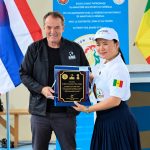
The story that now links Timur Kemmel to the Everest Judo Club began in Budapest, at the headquarters of the International Judo Federation -IJF-, where its president, Marius Vizer, welcomed the Kazakh guest, who had previously attended several World Judo Tour events. From that conversation came Nepal, and with Nepal came the idea of travelling to the Khumbu Valley, the region that leads to Everest and that has long been part of Sabrina Filzmoser’s work in developing judo in the Himalayas.
A few weeks later, Kemmel and Filzmoser met in Kathmandu. He was preparing to climb Lobuche East, which rises to 6,119 metres above sea level, while the Austrian judoka was once again setting in motion her Forever Everest 2026 project, described by the IJF as a symbolic and physical journey from the lowest point in Nepal to the roof of the world. In that meeting, the mountain quickly moved into the background and the conversation turned to another reality that has been established in Khumbu for years: that of the Everest Judo Club, presented by the international federation as the highest judo club in the world.
From the meeting in Kathmandu to the Everest Judo Club
From that point on, the story stopped revolving solely around Kemmel’s journey and began to focus on the conditions in which part of the region’s youth train. The IJF itself explains that what started as a project gradually became a support network for local children and teenagers. In that conversation, a number of practical questions emerged: how much more could be done, what everyday life was really like in such a remote area, and what young judoka needed in order to sustain both their sporting and educational development in a territory shaped by distance, climate and limited resources.
Among the stories Filzmoser shared with Kemmel was that of Priti, identified by the IJF as the first female black belt in the region. Through that case, the Kazakh visitor came to understand more clearly the context in which the Everest Judo Club operates: harsh living conditions, limited resources, a modest dojo and a fragile education system weighed down by geography. In another of its features on Nepal, the IJF had also reported that the work carried out through Everest Judo had helped support Preeti’s education outside her mountain community and had also opened a path for her as a coach.
 Timur Kemmel’s support in Khumbu
After learning about that reality, Kemmel decided to act during his time in Khumbu. The IJF reported that he visited the Sir Edmund Hillary School and delivered material support to the local judo community: 15 judogi, along with thermoses, blankets and backpacks. As presented by the federation, the gesture carried clear practical value in an area where access to basic equipment is not guaranteed and where the development of judo also depends on continued outside support, both for training and for the students’ everyday lives.
The episode also fits into a broader structure of international support around the project. In March 2025, the IJF announced that the Yosh Uchida Legacy Foundation -YULF- had begun supporting Everest Judo, a step the federation itself described as important to secure the future of its activities not only in Nepal, but across the wider region. The partnership is intended to sustain programmes linked to education, healthcare, training, equipment, local coaches and development opportunities for young talent in the Himalayas.
Sabrina Filzmoser and the origins of the project in the Himalayas
The second half of this story belongs to Sabrina Filzmoser and to work that did not begin now. In the official presentation of Everest Judo, the former Austrian judoka traces the origin of everything back to 2005, when she first travelled to Nepal to hike and climb in the Solu Khumbu region. That contact with life in the mountains of the Himalayas later led to another key moment: the London Olympic Games in 2012. There, after finishing seventh, she came into contact with the small team from Bhutan during the closing ceremony, a relationship that opened the way to a period of continued support for local judo, including the delivery of sports equipment, the push to build a dojo and scholarships for young judoka. The project’s own website explains that, from that base in Bhutan, Everest Judo later expanded its activity into Nepal, supporting schools, orphanages, children with disabilities and young people in need.
That path later produced a specific institutional outcome in Khumbu. According to the project’s official information, in 2022 the rural municipality of Khumbu Pasang Lhamu introduced judo as physical education in all schools across the area, within an initiative that Filzmoser directly links to education and to the use of sport as a tool for development. In that same context, the Austrian says: “Without the right to proper education, the values of freedom, justice, and equality have no meaning. A good education is the perfect way to bridge the gap between different cultures and reconcile them. Ignorance is by far the greatest danger and threat to humanity.”
 Last related articles