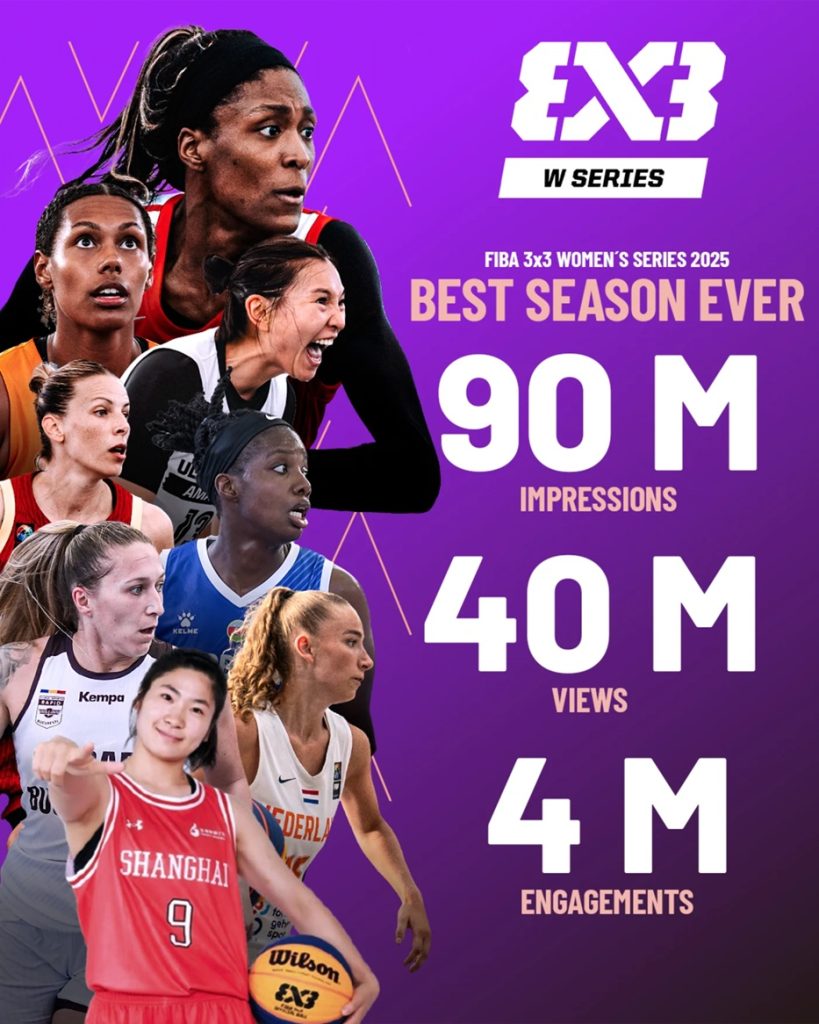
The FIBA 3×3 Women’s Series 2025 has wrapped up a landmark season, achieving record numbers across all its digital indicators. The final event held in Shanghai recorded 5.1 million views, a 13% increase from 2024, alongside 13.5 million impressions (+141%) and 1.1 million engagements (+450%). Across the entire season, the 15 tournaments averaged 2.4 million views per event (+14% vs. 2024), over 273,000 engagements (+102%), and a reach of 5.8 million users (+132%). This progress confirms sustained growth driven by increasing investment, visibility, and strategic partnerships.
Since its launch in 2019, the Women’s Series has doubled its calendar, becoming the leading international circuit for women’s basketball in urban format. Its inaugural season featured 15 events, a figure that fell in 2020 due to the pandemic but rebounded to 23 tournaments in 2023, with a total prize pool exceeding one million dollars. In 2022, the prize for the Final winner rose to 40,000 USD, while the 2024 season reached 41 million views and 50 million impressions across digital platforms—setting the stage for another leap in 2025.
Digital growth across the 3×3 ecosystem
The rise of the women’s circuit is part of a broader global expansion of the 3×3 format. According to FIBA, the overall 3×3 ecosystem surpassed 1.5 billion views and over 90 million engagements in 2025, representing year-on-year increases of 12% and 8%, respectively. The men’s World Tour maintained its strong momentum, with 366 million impressions (+46%) and 352 million views (+76%) in 2024, while the Women’s Series posted even higher relative growth rates. In the Europe Cup, impressions climbed from 30 to 37.6 million between 2024 and 2025, underscoring the format’s continued continental expansion.
International viewership has risen sharply in Asia, with China and Mongolia emerging as key markets, and in Europe, where France and Spain rank among the top countries for digital engagement. The joint campaign with ELLE, under the theme “Her Wings, Her Wins”, brought together seven international ambassadors and showcased the multicultural identity of women’s 3×3 basketball. Short-form content, player stories, and urban backdrops have turned TikTok and Reels into the main engagement drivers of the series.
Digital strategy and commercial consolidation
FIBA’s digital expansion is powered by content automation and direct athlete participation. Platforms such as WSC Sports enable real-time highlight generation, while Greenfly allows instant distribution of clips to players and teams, boosting organic reach across networks. This “player-first” approach has multiplied media exposure and strengthened emotional connections with fans. In 2024 alone, TikTok followers grew by 58%, from 1.7 to 2.7 million, contributing to a total 3×3 audience of more than 8 million across platforms.
On the commercial side, the 2025 season represents a turning point. The entry of AWSN (All Women’s Sports Network), broadcasting the Women’s Series globally in 2025–2026, enhances international distribution alongside the European Broadcasting Union (EBU) and Deutsche Telekom. The partnership with Redwings secures the organization of the Women’s Series Final in Shanghai through 2028, while Wilson continues as the official 3×3 game ball supplier for the same period. Collaborations with non-endemic brands such as ELLE broaden the circuit’s cultural reach and reinforce its brand value.
On the road to Los Angeles 2028
Digital growth and commercial stability position the Women’s Series as a key pillar on the road to Los Angeles 2028, where 3×3 basketball will once again feature on the Olympic program. During the Paris 2024 Olympic Games, 3×3-related content generated 195 million impressions and 132 million views, anticipating another surge in engagement ahead of the next Olympic cycle. FIBA projects annual digital growth above 20% between 2025 and 2028, driven by the expansion of host cities and new media partnerships.
In parallel, the federation continues to strengthen the grassroots structure of women’s 3×3, with over 70 active national programs in 2025 and a 30% increase in sanctioned tournaments compared to 2023. The institutional goal is to ensure a consistent talent pipeline toward elite competition and secure gender balance across all levels, in line with the International Olympic Committee (IOC) principles on equality and the promotion of urban sport.
 Last related articles