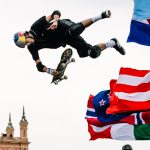
Istanbul hosted a Parkour World Cup from 4 to 7 June marked by the double victory of Noa Man, who won the women’s Speed and Freestyle events and turned the first competition of this level held in the Turkish city into another display of her dominance on the circuit. The event took place at Galataport Clock Tower Square, an urban setting that matched the identity of a discipline built around obstacles, speed, creativity and direct contact with the public.
The event was part of the international parkour calendar of the International Gymnastics Federation -FIG-, which structures competition around two main formats. In Speed, athletes must complete an obstacle course in the shortest possible time. In Freestyle, the result depends on difficulty, execution, flow and use of space. Istanbul therefore closed a phase of the 2026 circuit that had already passed through Montpellier and once again showed parkour’s ability to work both as competition and as an urban spectacle.
Noa Man sets the pace for the season
Man arrived in Istanbul after winning the Speed event in Montpellier and left Türkiye with three victories from four possible World Cup events in 2026. The Dutch athlete already knew what it meant to dominate both disciplines at the same stop, having done so in Amsterdam last year, but her performance in the Turkish city carried added value because of the way she solved two very different finals.
In Speed, Man did not start as the absolute reference point of the competition. She was third in the initial heats, but cut six seconds from her time in the final and beat Marta Gutierrez by more than a second. Lola Roy completed the podium, while Miranda Tibbling, who had been the top qualifier, finished fifth. In Freestyle, Man responded to the disappointment of Montpellier, where a missed double cork had left her without a medal, with a routine carrying a 14.0 difficulty score, the highest of the final, and a total score of 23.6.
Acimis claims local silver and world champions return to the top
The silver medal won by Irem Acimis in women’s Freestyle gave the competition a particularly relevant local angle. The 17-year-old Turkish athlete claimed her first World Cup podium after taking bronze at the Junior World Championships in 2024. After the competition, she wrote on Instagram that “the applause and support” she received during the event gave her more strength than she had imagined, adding that after injuries, sacrifices and difficult days, the result was “a harbinger of new beginnings”.
In the men’s competition, Istanbul also returned two world champions to prominence. Elis Torhall, the reigning Freestyle world champion, won with 31.2 points in his first World Cup appearance in two years, backed by an 18.2 difficulty routine that included a triple back from the bar. In Speed, Caryl Cordt-Moller went from a very tight qualification round to winning the final in 22.912, just 0.002 ahead of Siebe van de Spijker, the winner in Montpellier. Tangui van Schingen finished third, 0.337 behind gold.
Istanbul leaves a new image for international parkour
The competition also produced several notable names around the podiums. In women’s Freestyle, Acimis finished second and Bara Krcmarova claimed her second consecutive World Cup bronze, while Ella Bucio, first in qualification, ended fifth. In men’s Freestyle, Shea Rudolph finished second behind Torhall, in a final where difficulty once again made the difference. In men’s Speed, Bohdan Kolmakov recorded the fastest time in the semifinals, but Cordt-Moller found one last improvement in the final to take gold.
The stop in Istanbul also allowed parkour to be placed in one of the city’s most recognisable environments. Galataport Clock Tower Square offered an image aligned with the nature of the discipline: visible courses, obstacles integrated into an open space, a close crowd and a competition rhythm that alternates explosiveness, precision and creativity. For a discipline born in the urban environment, the choice of venue added value beyond the sporting result.
 Last related articles