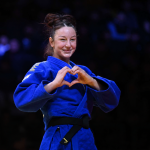
Masai Russell ran 12.14 in the 100m hurdles at the Diamond League meeting in Xiamen, a performance that left her just 0.02 seconds shy of Tobi Amusan’s world record and made her the second-fastest woman in history in the event. The run came after her Olympic gold in Paris 2024 and confirmed that the American has moved from winning by the finest margins to operating directly in world-record territory. “I don’t know when the world record will come, but I’m getting closer and closer,” she said after her race in China.
The mark in Xiamen explains her sporting present, but her figure is better understood through the career she has built around the track. Russell presents herself on her website as an athlete, influencer and vlogger, with interests spanning athletics, beauty, fashion, style, make-up, hairstyles, travel and female entrepreneurship. Her own narrative speaks of showing “the beauty of track and field” through sportswear, make-up, hairstyles and dance, a way of bringing the track closer to audiences who may not come to athletics through the clock alone.
The athlete who reached the elite with her own camera
Russell began building content during her college years, just as name, image and likeness -NIL- rules were changing the business of American college sport. Her digital ecosystem includes training sessions, make-up routines, travel, fashion, collaborations and competition vlogs. She also presents her commercial deals as part of that identity, to the point of defining herself as the first female college athlete to sign an NIL deal. That presence fits naturally with formats such as Athlos, the women’s athletics event launched in New York, where competition is mixed with spectacle, pop culture, major prize money and new ways of presenting athletes.
The scene described by KRNL Magazine at Kentucky’s indoor training facility captures that construction. Russell appears like an influencer ready for a photo shoot, with lashes, tooth gems and brown UGG boots, in the same space where an athlete who had already broken the collegiate 100m hurdles record and the United States Olympic trials record was training. That coexistence of aesthetics and performance works as a language of her own: Russell presents herself as strong, fast, prepared and visible on her own terms. She has also linked make-up to competitive confidence, explaining that it helps her activate a kind of “alter ego” before racing.
 Family, school and a protected career
Her entry into athletics had a family origin. As a child, she did gymnastics and ballet, but she arrived at the track because her mother took one of her brothers to a competition and she wanted to try it after seeing what he was doing. She started running at eight or nine and has repeatedly said that track has been the competitive sport of her whole life. She later attended Bullis School, in Maryland, where she graduated in 2018, and then the University of Kentucky, within an American system in which school and college are central parts of athletic development.
Her family also helped organise her career away from the track. Her mother, Sharon Russell, is an oral and maxillofacial surgeon; her father, Mark Russell, runs the family medical practice and was her first track coach. During her college years, Sharon Russell reviewed potential NIL contracts to protect her daughter from unclear clauses or excessive transfers of rights, with support from India Russell-Pena, a lawyer and relative of the athlete. That caution also appears in the way Russell talks about business: “There’s money involved, people’s careers are involved,” she said. “I don’t want to have any setbacks over something I can control.”
From the smallest margin to a world-record chase
Russell’s sporting evolution also has a mental layer. At Kentucky, she competed in the 60m hurdles, 100m hurdles, 400m hurdles and relays, a range that explains her technical and competitive base. After moving into the senior elite, she acknowledged having to overcome fear, doubt and concern about hitting hurdles during races, a block that affected her consistency before she began to feel in control again. “I was battling with some self-doubt, trying to prove to everybody who I was, rather than performing from the place of who I know I am,” she explained before Xiamen. After missing out on a medal at the World Indoor Championships in Glasgow, she also summed up that process with a line of learning: “It was just a test to get to the testimony.”
The breakthrough was confirmed in 2024, when she won the United States Olympic trials in 12.25 and then became Olympic champion in Paris in 12.33, by just one hundredth over France’s Cyrena Samba-Mayela. In 2025, she lowered the American record to 12.17 and in Xiamen she cut it again to 12.14, two hundredths off the world record. “I didn’t medal, but I guess that’s what they wanted to see. And I just carried that momentum into outdoors,” she said of the transition that ultimately took her towards her best version. Russell now stands as an Olympic champion, the second-fastest woman of all time and a figure who understands the track, the camera and personal branding as connected parts of the same career.
 Last related articles