The judo events at the 2026 Mediterranean Games bring together judokas from across the region on the tatami, with seasoned international athletes sharing the stage with young competitors looking to make a name for themselves. At the heart of the action is Roberta Chyurlia, an Italian referee whose return to Puglia holds special significance after years spent officiating at the highest levels of judo.
For Chyurlia, these Games are her second Mediterranean Games after Tarragona 2018, but the setting in Martina Franca makes this edition different. She is back officiating in Italy and in her own region, something she describes as a special experience after spending much of her career travelling for international competitions.
“It is a fantastic experience for me to be here because, after such a long time, I am back officiating in Italy,” she said. “To participate in these Mediterranean Games at home, in my own region, is really a special emotion.”
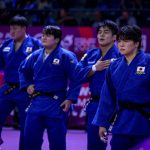
The competition itself reflects the different priorities of the countries taking part. Several athletes competing in Martina Franca have experience on the international circuit, raising the standard of the tournament, while some nations have chosen to give younger judoka an opportunity because the Lausanne Grand Slam is taking place at the same time. For those younger athletes, the Games offer a chance to compete against strong opposition and gain experience that cannot be replicated in domestic competition.
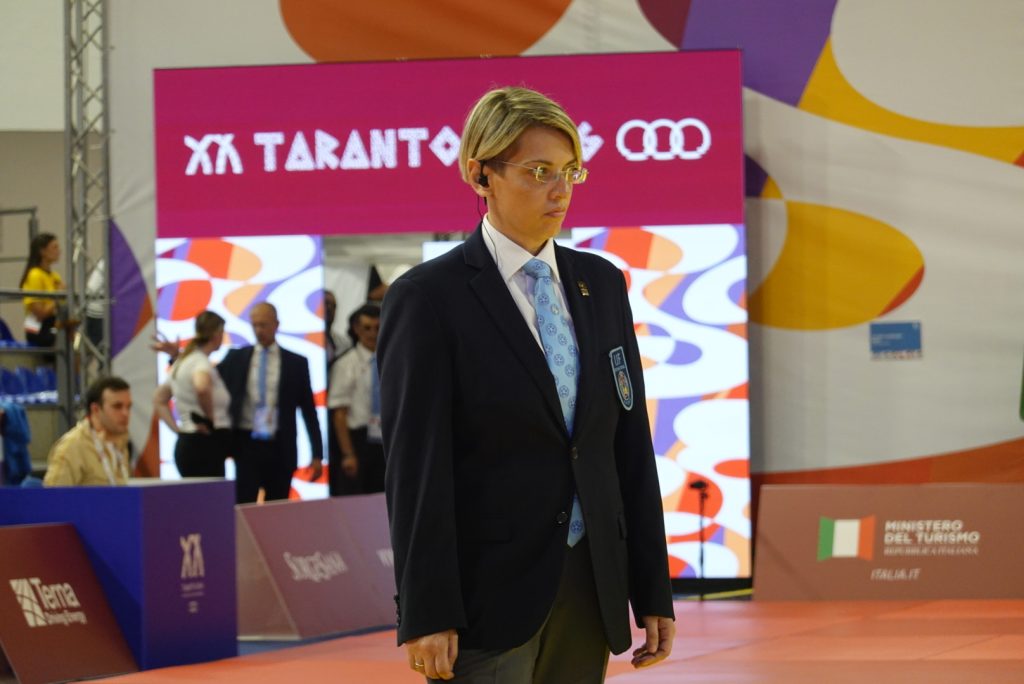
Roberta Chyurlia – Taranto 2026
Chyurlia understands that progression well. She began refereeing in 2004 after finishing her career as a national-level athlete, became a continental referee in 2012 and reached world referee level in 2015. She was the first Italian woman to achieve that distinction, and her career has since taken her to two Olympic Games, Tokyo and Paris. The route to the top has not become easier with experience, however, and she says the ambition remains to earn another Olympic appointment.
Her career also comes at a time when women are becoming increasingly visible in judo refereeing. Chyurlia believes the International Judo Federation has placed significant emphasis on women’s qualities and professional ability, while Italy has also encouraged more young people and women to enter refereeing. She has seen more young women moving towards the profession in recent years, including those attending the IJF Academy, which she considers an important part of the education and development of referees.
For Chyurlia, greater participation by women is meaningful only if they are given the opportunity to develop to the same level as everyone else. Her own career provides a clear example of what that route can lead to, but she does not see gender as the defining factor. “If a person commits themselves, regardless of whether they are a woman or a man, they can achieve their goals,” she said. Her emphasis is on preparation, commitment and the ability to meet the standards required at international level.
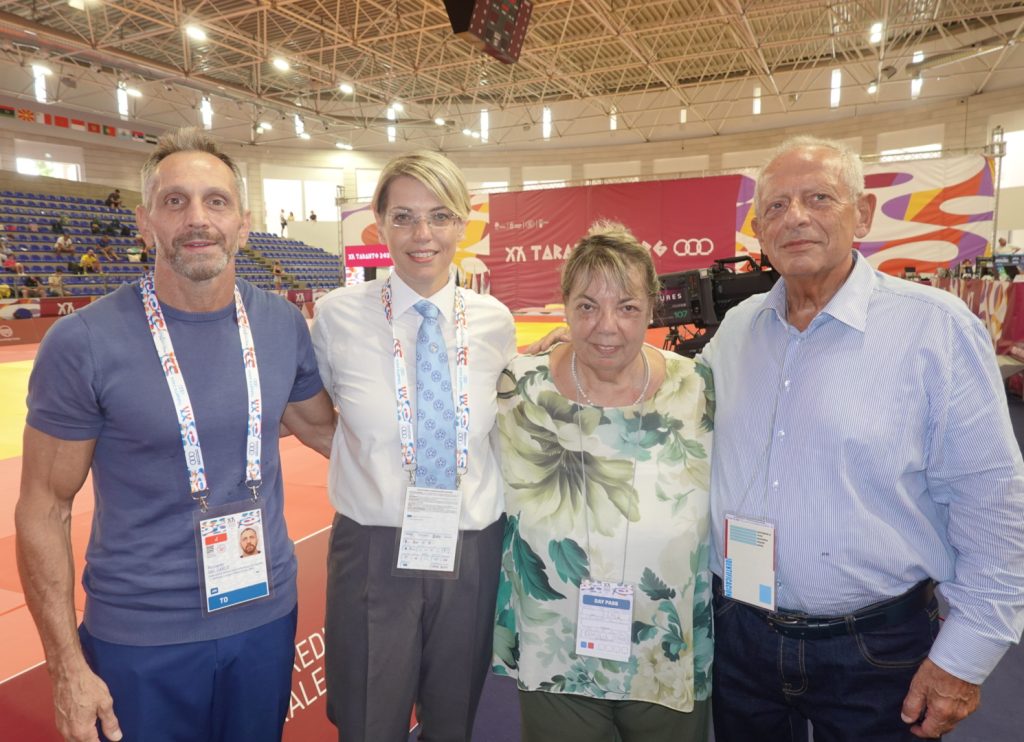
Robertas’ family
Those standards become increasingly demanding as referees move towards the biggest competitions. Chyurlia says remaining at the top requires the same discipline that is expected of the athletes on the tatami. “It is very important to always be ready and to maintain the standards that have been achieved,” she said. After Olympic assignments in Tokyo and Paris, she knows that every new tournament brings another test, with the next opportunity having to be earned rather than assumed.
There is also a family reason why judo has such a central place in Chyurlia’s life. She comes from a family deeply involved in the sport. Her father is an Olympic referee, her mother has worked as an official in the national federation and her husband is a world referee. The sport has therefore been part of the family for years, shaping not only her career but also the environment in which she developed as an athlete and later as an international referee.
That connection makes her presence in Puglia particularly personal. While the Mediterranean Games provide a major international platform for the athletes competing in Martina Franca, Chyurlia is also returning to a region that is closely linked to her own sporting identity. “My whole family is involved in judo,” she said. “For me, it is a great source of pride to be here and I hope to make them proud as well.” Her story also offers a visible example to the young women now entering refereeing and looking towards the international level.
The Mediterranean Games will ultimately be decided by the athletes and the medals they win, but the judo competition in Martina Franca is also showing how the sport is changing beyond the results. Younger judoka are gaining experience, more women are moving into refereeing and experienced officials such as Chyurlia continue to work towards the highest standards. For the Italian referee, the next objective remains clear after Tokyo and Paris. Another Olympic Games is still the goal.
 Last related articles