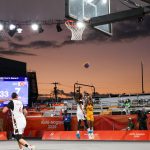
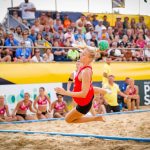
The FIBA 3×3 Europe Cup Crelan 2026 brought 24 national teams —12 men’s and 12 women’s— to a temporary arena in Groenplaats, in the heart of Antwerp, from 11 to 13 September. Latvia won the men’s title to complete a double after also becoming world champions earlier this year, while the Netherlands successfully defended their women’s crown and claimed a third European championship in four editions. The results produced the champions, but the main institutional takeaway came from the depth of the field, the arrival of new countries and the ability to stage a continental competition in the centre of a city.
Strahinja Stojacic described the event as “the strongest Europe Cup ever”. His assessment came after top men’s seeds Serbia shared a pool with Switzerland, the 2025 world runners-up, and hosts Belgium, before facing defending European champions Lithuania in the Quarter-Finals. “More players and more countries are investing in 3×3 basketball,” he explained, “and that’s raising the level of competition year after year.” His words describe an evolution that extends beyond improvements in individual quality: an increasing number of federations now have national teams capable of reaching the knockout rounds, competing for medals and disrupting the established order.
A broader competitive map
The men’s podium reflected part of that transformation. Latvia regained the European title nine years after their 2017 triumph, the Netherlands recorded their best result with silver after bronze medals in 2016 and 2022, and France returned to the podium for the first time since finishing second in 2019. In the women’s competition, the Dutch extended a sequence that includes titles in 2023, 2025 and 2026, but Spain reached the Final with a renewed team and Azerbaijan finished third. With the six medals shared among six different countries, FIBA was able to present a competition without a single national programme dominating both draws.
The expansion was also visible beyond the podium. Estonia made their men’s Europe Cup debut and Sweden appeared in the women’s event for the first time, recording a pool-stage victory over Czechia. The Czech team returned to the Quarter-Finals after missing the 2024 and 2025 editions, while Slovenia competed for the first time since 2016 and reached their first Semi-Finals since 2014. The Belgian women, absent since 2021, also returned to the championship in front of their home crowd. These debuts and returns broaden the group of federations with continental experience and allow the Europe Cup to function as more than an annual meeting of the established powers.
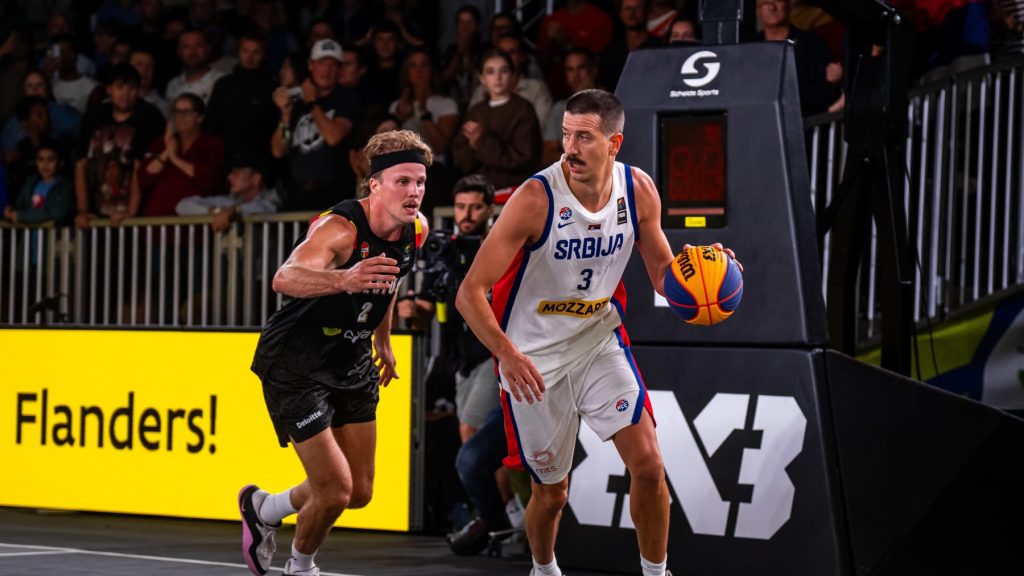
A court in the city centre
FIBA did not stage the competition in a conventional indoor arena, but on a temporary court built in Groenplaats, one of the main squares in central Antwerp. More than 7,000 spectators attended during the opening two days, while every seat for both sessions on the final day sold out. The setting brought the national teams into a space integrated into the daily life of the city and placed the action only metres away from the crowd, an arrangement consistent with a discipline derived from urban basketball and played on a half-court.
The format also turns the competition into a flexible event property for organisers and commercial partners. Belgian bank Crelan occupied the title-sponsor position in the official name of the championship, while Antwerp provided a recognisable setting without needing to build a permanent venue. The combination of a removable court, four-player squads and ten-minute games makes it possible to stage both the men’s and women’s draws over three days at the same location. For FIBA, the model delivers international competition, brand exposure and urban activity on a smaller organisational scale than a conventional five-a-side basketball championship.
Two ways to build continuity
The champions represented two different processes. Latvia defeated the Netherlands 19-10 in the men’s Final and added the continental crown to the World Cup title secured earlier in the season. Kristaps Gluditis, named the tournament’s Most Valuable Player, finished with 32 points and nine successful two-pointers. In the women’s Final, the Netherlands beat Spain 16-13 to defend the championship won in 2025. Noortje Driessen collected her second consecutive MVP award after leading the tournament with 44 points and a Player Value score of 50.7. The national team retained a core accustomed to competing together in both national-team events and the Women’s Series.
The Europe Cup forms part of a structure through which FIBA connects the work of national federations with different levels of competition. Senior national teams compete at the World Cup and continental championships; professional teams have the World Tour and Women’s Series; and developing age groups progress through the Youth Nations League and youth World Cups. Two days after the Antwerp Final, Wuhan will host the U23 World Cup, featuring 40 men’s and women’s national teams. The calendar therefore connects a continental competition staged in the centre of a European city with the next generational level of an international circuit that continues to incorporate countries, athletes and host locations.
 Last related articles