World Gymnastics has acknowledged that its decision to restore full national representation for athletes from Russia and Belarus cannot be implemented identically at every competition. The International Gymnastics Federation -FIG- maintains that participation under national flags, anthems, country codes and symbols should remain the general principle, but will allow transitional exceptions at events awarded before the policy change when binding government measures apply in the host country.
The clarification does not alter the readmission approved in May or reinstate the previous system for individual neutral athletes. It does, however, introduce a practical limit to its compulsory application: the federation can determine who is eligible to compete, but cannot override national laws or government decisions. Consequently, some gymnasts will be able to represent their countries fully, while others may temporarily have to compete without national symbols depending on the location of the event.
The May decision remains in force
FIG excluded Russian and Belarusian athletes and officials in March 2022 following the invasion of Ukraine. In July 2023, it established a pathway for their return as individual neutral athletes, effective from January 2024 and governed by special rules that removed flags, anthems and national references. On 18 May 2026, its Executive Committee lifted all restrictions with immediate effect and abolished that specific framework. The decision once again permitted participation under full national identity.
The change preceded a decision adopted on 7 July by the International Olympic Committee -IOC-, which recommended ending the neutral eligibility assessment system for Russian athletes, although it did not confirm whether they would be allowed to use their flag and anthem at the Olympic Games. After considering the difficulties raised by several hosts, the World Gymnastics Executive Committee reviewed the implementation of its policy during its meeting from 22 to 24 July. The federation stated that it was “not reconsidering its decision”, but acknowledged that “a degree of flexibility may be required” for previously awarded events.
Europe turns the exception into a transitional framework
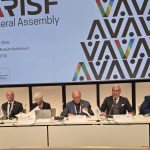
European Gymnastics incorporated that solution into its calendar through an Extraordinary General Assembly held on 28 July. The meeting was attended by 46 national federations, which ratified the readmission of Russia and Belarus and approved the application of the transitional framework to European competitions awarded before that date. The European cut-off is broader than the one established by World Gymnastics, which applies to events allocated before its decision of 18 May.
The exception may only be activated when a government institution provides written confirmation of a binding measure. If that decision prevents the use of a national flag, anthem, country code or any official identifier, the World Gymnastics flag will replace the national one and neutral music will be played. National emblems will also be prohibited on competition, warm-up and ceremony uniforms, apparatus, clothing, equipment, accessories and personal belongings. Each situation will be agreed with the host country without reinstating the special rules that previously assessed the individual eligibility of each athlete.
Participation, representation and institutional authority
European reintegration is also proceeding at administrative level. Representatives from the Russian Gymnastics Federation and the Belarus Gymnastics Association will immediately resume their roles within European Gymnastics. Two institutional restrictions remain in place: no European Gymnastics events will be awarded to or organised in Russia, and Russian government or state officials will not be invited to the organisation’s events. The agreement therefore distinguishes between athlete eligibility, the use of national symbols, participation in governing bodies and the right to host competitions.
In practice, the transitional framework allows events awarded under the previous conditions to remain in place without automatically requiring relocation or cancellation, but it creates different territorial applications of the same policy. New hosts should be prepared to guarantee full national representation because the exception is limited to events awarded before the change. World Gymnastics has approved a provisional list of host federations for its 2027 and 2028 World Cups and World Challenge Cups, although it has yet to publish the final calendar or explain what procedure would apply if a future host subsequently introduced restrictions incompatible with its general framework.
 Last related articles