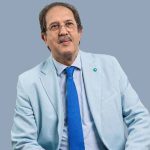
At the 20th edition of the Mediterranean Games in Taranto, I had the opportunity to sit down with Mustapha Berraf, President of the Association of National Olympic Committees of Africa, and gain insight into the views of a man whose many years at the highest levels of international sport have given him a unique perspective on the Olympic Movement.
In addition to leading ANOCA, President Berraf is a member of the International Olympic Committee, which has elected its first female president from the African continent, underlining its commitment to ensuring that the Olympic Movement reaches every part of the world without discrimination, including Africa.
With 54 National Olympic Committees, Africa is one of the largest and most diverse continents within the Olympic Movement. Its sporting landscape requires a particular understanding of the very different cultural, economic and infrastructural realities across the continent. After years at the helm of African sport, President Berraf is well aware that each of these 54 National Olympic Committees operates within its own unique circumstances, while also facing challenges that can have a direct impact on the development of sport.
A conversation with someone of President Berraf’s experience therefore offers a valuable perspective, particularly at a time when the Olympic Movement is seeking to strengthen cooperation and ensure greater inclusion across continents. He also appears to enjoy considerable respect among representatives of the countries participating in the Mediterranean Games.
For these reasons, I decided to present this interview in a question-and-answer format, allowing President Berraf’s views and the directness of his responses to speak for themselves.
Mr President, thank you very much for accepting my invitation to speak with SportsIn.
Now that we are here in Taranto for the 2026 Mediterranean Games, how do you see the significance of these Games beyond sport? What do they represent for the people and communities of the Mediterranean region?
“The Mediterranean Games demonstrate how a shared regional identity can become a genuine instrument of international cooperation. At the crossroads of Africa, Asia and Europe, the Mediterranean brings together different realities, but also a deeply shared future. These Games provide a unique space for peace, dialogue and exchange across cultures, where diversity becomes a force for bringing people closer together. Their value should therefore be measured not only by sporting performance, but also by their ability to build trust and forge lasting bonds between peoples.”
You are here alongside athletes and National Olympic Committees from across the Mediterranean. What message would you like to convey about the role these Games should play within the wider global sports movement?
“I have had the privilege of experiencing the Mediterranean Games since Algiers 1975, first as an athlete, then as a technical expert and later as a sports leader. This journey has allowed me to witness their evolution and understand their full potential. Their unique strength lies precisely in bringing together three continents. We should turn this proximity into a genuine platform for cooperation among NOCs by promoting the sharing of expertise, training, athlete preparation and innovation. The Olympic Movement will be stronger when it is able to combine a global vision with structured regional cooperation and the capacity to act as closely as possible to national realities.”
Based on your experience working with the International Olympic Committee and with National Olympic Committees of very different sizes, resources and circumstances, what do you believe are the most important common needs of NOCs today, particularly across Africa, Asia and Europe?
“NOCs operate in different realities, but their fundamental needs converge: strong institutions, enhanced capabilities, the capacity to drive their digital transformation, diversified resources and more equitable access to expertise and opportunities. Differences in size or resources should never translate into differences in the capacity to act. Our collective responsibility is to enable every NOC to fulfil its mission and contribute to an Olympic Movement that is stronger, more balanced and better prepared for the transformations ahead.”
Looking back at your years of leadership within ANOCA, what lessons and experiences do you believe could be applied for the benefit and advancement of the Olympic family as a whole?
“My experience at ANOCA has deeply convinced me that an organisation is stronger when it succeeds in turning its diversity into a collective strength. Fifty-four NOCs mean fifty-four different institutional, economic and cultural realities. This requires governance grounded in dialogue, proximity, responsiveness to realities on the ground and a genuine culture of results. This experience extends beyond Africa: it has taught me that effective governance is not about applying the same solutions everywhere, but about pursuing common objectives while taking into account the realities of each member.”
How can we further strengthen the opportunities available to every National Olympic Committee, regardless of its size, resources or continent, to contribute to the Olympic Movement, have its voice heard and play a meaningful and effective role?
“We must move beyond a logic of representation towards a genuine culture of participation. Every NOC should be heard, contribute to shaping decisions and play a full part in defining the strategic direction of our Movement. The strength of the Olympic Family lies in its 206 NOCs: no voice should be left at the margins, and every NOC should have a meaningful role in shaping our collective future.”
Finally, what message would you like to send from Taranto to the athletes and National Olympic Committees of Africa, Asia and Europe, and to the Olympic family as a whole around the world?
“From Taranto, I would like to convey a message of confidence and responsibility. The world is changing, and our Movement must be able to evolve with it while remaining faithful to the values that are its greatest strength. Our responsibility is to prepare for the future: to anticipate the transformations ahead, to pass on a stronger Olympic Movement to the generations that follow, and to preserve sport’s unique ability to bring people together across differences. This also means giving athletes their rightful place in shaping the future of our Movement and enabling those who wish to do so to become the leaders of tomorrow. Their experience, their voice and their commitment are essential. This is the collective responsibility we must carry forward together.”
Thank you again Mr President Mustapha Berraf
 Last related articles