Alaaeldin Kamel Hassan spoke to SportsIn before Egypt’s weightlifters had lifted a single medal in Taranto. What followed gave his ambitious vision for Los Angeles 2028 a powerful early endorsement.
When Alaaeldin Kamel Hassan spoke to SportsIn on the opening day of the weightlifting competition at the Taranto 2026 Mediterranean Games, Egypt’s campaign was still waiting to unfold. There were no medals to point to, no podium celebrations and no results to support his confidence. Yet the head coach of Egypt’s national weightlifting team spoke with a clear sense of purpose. “We have high expectations,” he said, making it clear that Taranto was not being viewed simply as another Mediterranean Games, but as part of a much larger project.
For Hassan, that project is already looking beyond Taranto and towards Los Angeles 2028. He explained that the preparation for the next Olympic cycle had effectively begun after Paris 2024, with particular attention being given to a younger generation of lifters. Among those he highlighted were Abdelrahman Younes, born in 2005, and Abdelrahman Hosny Metwally, born in 2008. Their presence, he suggested, reflects an important change in the way Egypt is thinking about the future of the sport. The objective is not simply to maintain the current generation, but to build the next one while the experience of established athletes remains available to them.
That approach is particularly significant for a country with a long tradition in weightlifting. Hassan described the sport as one of the important pillars of Egyptian sport and repeatedly returned to the importance of creating a strong national system rather than relying solely on individual champions. His ambition is to have athletes capable of competing consistently at the highest international level.
“We want to build a team that can compete for medals,” Hassan said.
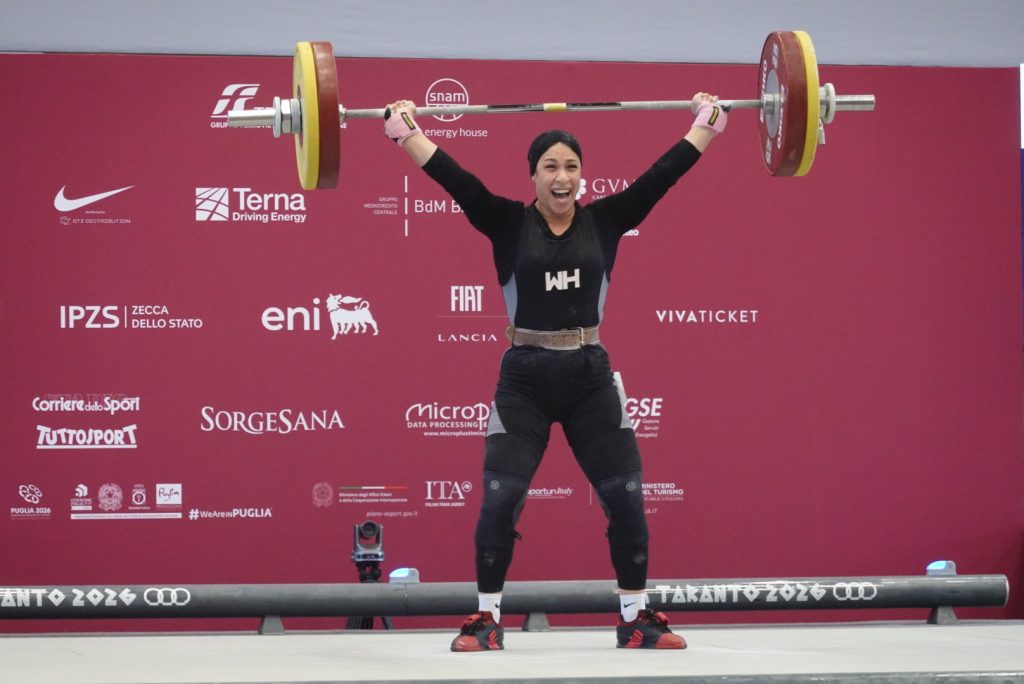
Hassan also spoke warmly about the support surrounding Egyptian sport, thanking President Abdel Fattah el-Sisi and the country’s Ministry of Youth and Sports. For him, investment in elite sport extends beyond the medal table. International competition provides Egypt with an opportunity to demonstrate its sporting strength and to strengthen the country’s presence on the global stage. Weightlifting, with its Olympic history and strong Egyptian tradition, has a particular role to play in that wider national sporting identity.
The Mediterranean Games, meanwhile, offered exactly the kind of environment Hassan wanted for his athletes. Egypt was competing alongside established weightlifting nations including Turkey, Italy, Spain, Tunisia and Algeria, providing a demanding test of both performance and preparation. Hassan acknowledged that technical standards can always be maintained and improved at the highest possible level, but his overall assessment was positive. The competition, he said, was valuable because it exposed his athletes to strong opponents and high-level pressure, experiences that cannot be reproduced entirely in training.
What happened on the platform subsequently gave his words a different weight. Egypt finished the weightlifting competition with 10 medals, including seven gold, two silver and one bronze, placing the Egyptian team at the top of the sport’s medal standings in Taranto. The result was not simply a successful medal haul. It offered an early indication that the rebuilding process Hassan had described was beginning to produce results.
Noureldin Zaky provided one of the first examples. In the men’s 65kg category, he won gold in the snatch and silver in the clean and jerk, with Italy’s Sergio Massidda taking the latter title after lifting 162kg to Zaky’s 161kg. The result illustrated another point Hassan had stressed in the interview: the value of competing against strong international opponents, particularly when small margins can separate gold from silver.
Roufida Fathi produced a similar story in the women’s 69kg competition, winning silver in the snatch before taking gold in the clean and jerk. Her performance was followed by two-gold-medal campaigns from Abdelrahman Younes in the men’s 85kg category and Sara Samir in the women’s 77kg division. Together, those performances reflected the balance Hassan had described between experienced athletes and the emerging generation, and showed that Egypt’s medal hopes were not dependent on one or two names.
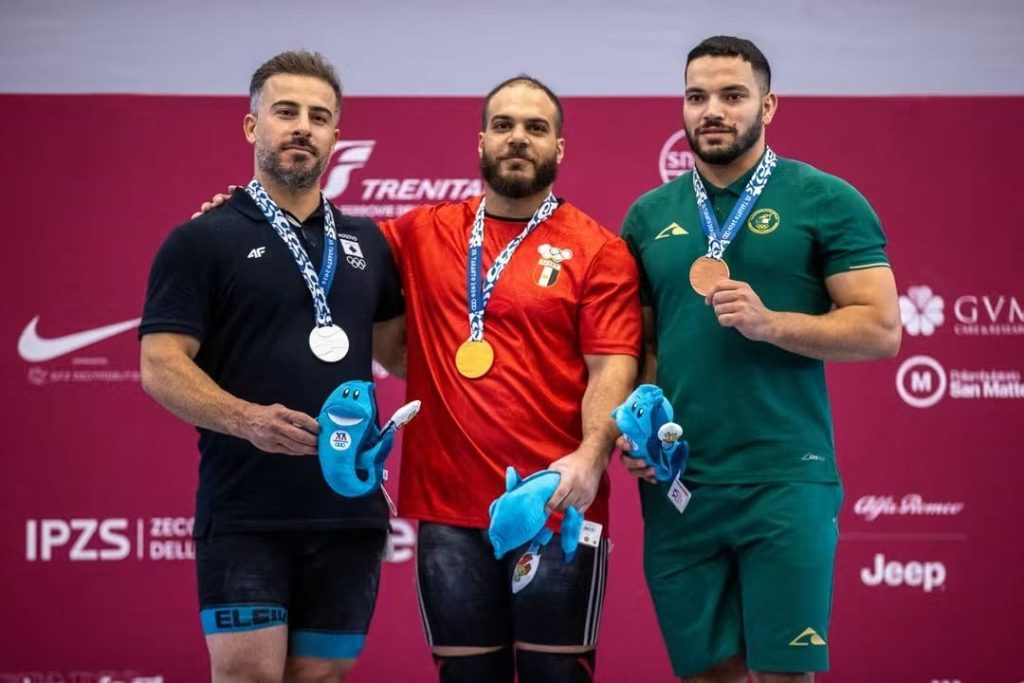
Karim Abokahla added another striking chapter in the men’s 95kg competition. He won bronze in the snatch before taking gold in the clean and jerk with a 204kg lift, finishing ahead of Kosovo’s Kianoush Rostami, who lifted 203kg for silver. It was precisely the kind of high-level contest Hassan had identified as important for his athletes, where a single kilogram could determine the colour of a medal.
Yet the most interesting part of Hassan’s message was that he did not speak about Taranto as the final destination. His focus remained on building a stronger national team and creating athletes capable of carrying Egypt’s weightlifting tradition into the next Olympic cycle. The Mediterranean Games were therefore a checkpoint, not the conclusion. The medals mattered, but what mattered more to the coach was what those performances could mean for the future.
Egypt’s overall performance in Taranto strengthened that argument. The country finished the Games with 58 medals, including 23 gold, 16 silver and 19 bronze, placing fifth overall and at the top of the Arab medal standings. Weightlifting was one of the strongest contributors to that campaign, producing 10 medals on its own.
 Last related articles