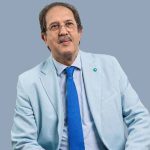
For Lasha Talakhadze, weightlifting is much more than a sport. It’s a legacy shaped by national pride and inspired by heroes like Giorgi Asanidze, Olympic champion in Athens 2004.
For Talakhadze, victory has never had meaning without the Georgian flag. A three-time Olympic gold medalist, he stood atop the podium in Rio 2016, Tokyo 2020, and Paris 2024, proudly listening to his national anthem echo across the arena.
His journey began at age 13 under the guidance of his father. By 17, he was already part of the Georgian junior national team and competed in the 2010 European Championships in Valencia. His early successes, including three gold medals during his formative years, solidified his commitment to the sport. That dedication took him beyond competition into leadership, where today he plays a key role in the development of Georgian weightlifting.
In 2026, Georgia will host the European Weightlifting Championships in Batumi, in collaboration with the European Weightlifting Federation under the new leadership of Astrit Hasani. The event, which takes place from April 19 to 26, brings together 368 athletes from 51 European countries, creating what Talakhadze describes as a memorable experience for all participants.

He expressed his gratitude to Prime Minister Irakli Kobakhidze, President Mikheil Kavelashvili, and Sports Minister Shalva Gogoladze, emphasizing that all members of the Adjara local government and the Georgian Weightlifting Federation contributed to the successful organization of the event.
Talakhadze is emphatic about weightlifting’s place within the Olympic movement. In his view, the Olympic Games are built on a foundation of fundamental sports, and weightlifting is one of them. Preserving that legacy, he insists, is a shared responsibility.
I invited him for an interview at the Hilton Batumi, where I was staying. Despite the competition, he graciously accepted and found time to speak with Sportsin, offering fans a deeper insight into his life and values.
Thank you, Lasha, for your time
During your speech at the opening ceremony, the audience chanted your name with tremendous passion. Where does that affection come from?
“I have always received great love and support from my people,” Talakhadze said. “That has been the main driving force in my life, the motivation that keeps me going. When you asked me this question, I realized that I can’t live a single second without Georgia.”

“We are a small country with a limited population, but what has allowed us to survive throughout the centuries is the love and humanity we share. We have always been united and supported each other.”
“We have a kind of ‘code’: our language, our land, and our religion. It may sound a bit political, but it’s part of who we are. That’s why we all feel a responsibility towards our country and our people.”
Let me make it a little more difficult. What does that sense of responsibility mean to you personally?
“Like many others, I have always tried to contribute to success in all areas, culture, sport and the international stage, because for a small country like ours that is very important.”
“I try to be present at training centers, both in large cities and in small towns, to give everyone the opportunity to test their strength and talent in weightlifting.”
Georgia has produced numerous weightlifting legends, such as Kakha Kakhiashvili, Giorgi Asanidze, and Irakli Turmanidze. Talakhadze believes it is essential to maintain this tradition by reaching out to communities throughout the country.

Through his achievements and leadership, Talakhadze not only preserves the proud Georgian tradition in this sport, but also reinforces his conviction that weightlifting remains an essential pillar of the Olympic Games.
How do you assess the place of weightlifting in the Olympic Games, considering the recent challenges this sport has faced?
“Lately, many people have tried to turn sport in general, and even the Olympic Games, into a business. In my opinion, that’s regrettable, because sport and business were never meant to be the same. Athletes dedicate their lives to this path, train hard, and even risk their health. That’s why talking about spectacle, commerce, and money in this context is inappropriate.”
“Some sports have been added to the Olympic program that, in my opinion, don’t fully reflect the original spirit of the Games. I don’t want to speak negatively about them, because even in those disciplines there are athletes who work very hard. But there are also those who focus more on the commercial aspect.”
“I think there should be less focus on reforming or replacing traditional sports. These are disciplines that have always been part of the Games and have defined their appeal. We shouldn’t try to reinvent the wheel.”
“The Olympic Games are closely linked to weightlifting. Traditional sports should be preserved. Instead of eliminating weightlifting, they should support it.”

He also highlighted that the Georgian government has allocated approximately 2.3 billion lari to the development of sports infrastructure, including training centers and bases for various disciplines such as weightlifting. He explained that this investment has been key to identifying and developing new talent.
How would you describe your relationship with the young Georgian weightlifters, Lasha?
“I try to stay as close as possible to the new generation,” he said. “I regularly attend their training sessions, I know them personally, and I spend time with them. I think I have a very close and friendly relationship with all of them.”
“I try to lead by example, offering advice and maintaining a friendly and approachable attitude. Not only as president of the federation, but also as a friend, an older brother, or a mentor. I want to encourage them to stay in weightlifting and continue on the path they have chosen in the sport.”
Fotos de Easy Sport
 Last related articles