Louise Seppey remembers skiing as something that came almost before memory. “Like many people in the Valais, I had skis on my feet as soon as I could walk,” she told Rhône FM. Born in Hérémence, the Swiss communicator grew up among slopes, clubs, ski schools and a connection with snow that never fully disappeared. Today, at 31, she works as Communications Coordinator at the International Ski and Snowboard Federation -FIS-, where she tries to tell sport from a place that goes beyond results, medals and rankings.
Her story begins on a path familiar to many mountain children. She competed until her teenage years, but between the ages of 15 and 16 she decided to stop and focus on her studies, a decision that felt “safer” for her future at the time. “Unlike many young people, I didn’t stop competing because I had fallen out of love with it; the joy of skiing was still there,” she explained. She then stayed connected to that environment: she taught at Ski Club Heremencia, earned her Youth and Sport qualifications and worked for the Swiss ski school. “I never completely left the world of skiing,” she says.
From Hérémence to FIS
Her academic path first took her away from the Valais. She studied a Bachelor’s degree in management in Saint Gallen and later completed a Master’s degree in sport and leisure management in Lausanne. During that period, she worked for almost three years at Ski Valais as communications manager, an experience she sees as decisive in helping her enter professional life. She later moved to Swiss Golf, where she combined communications and club services for just over two and a half years before returning to the world of snow sports.
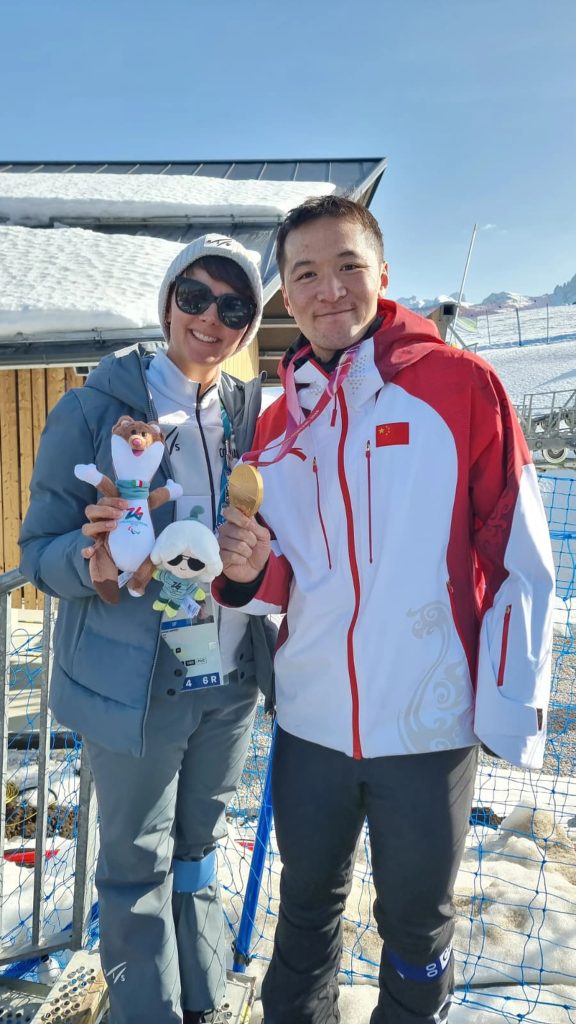
Seppey joined FIS in December 2023, after a former Swiss Golf colleague sent her the job opening, convinced that she matched the profile. She wanted to understand from the inside how “a big boat”, a major international federation, worked, and found an organisation different from the one she had imagined. “I had this image of a federation run by relatively older people, but I met many colleagues my age,” she said. Working with dynamic people from her own generation, with a shared view of a sport in constant evolution, is one of the things she values most about this stage. She also experienced her first Games: “I had goosebumps at the first competition in Cortina,” she recalled, after seeing athletes she already knew from World Cups compete in front of packed stands, media and a busy mixed zone.
 “Humans connect with humans”
For Seppey, sports communication must start from a simple idea: “Humans connect with humans.” Before the Games, the team focused on telling human stories and giving athletes a platform to show who they are beyond competition. “Even if someone’s not a skier or snowboarder, they can still connect with a snow sports athlete through their story and experiences,” she explained to Inside FIS. That perspective captures much of the way she understands her work.
She also believes Para athletes should be part of the wider snow sports story, not treated as a separate category, but as athletes competing on the biggest stage. “At the end of the day, they’re athletes performing on the very biggest stage, and they deserve that visibility,” she said. That is why one of her goals is to keep the momentum of the Games going during the off-season, with content focused on athletes, training sessions, everyday life, archive material and behind-the-scenes stories ahead of a new World Championships season.
Leadership, diversity and new voices
Her participation in the FIS Women Lead Sports programme also strengthened a personal conviction: women belong in the sports industry and must be present in decision-making spaces. “It reassured me that women absolutely belong in the sports industry, in any industry in fact,” she said. For Seppey, diversity is not limited to gender; it also includes culture, generation and different ways of looking at the same problem.
That view connects with the way she works. She describes herself as “a bit of a generalist”: not an expert in just one thing, but someone able to understand the bigger picture, bring experts together, build a narrative and tell a complete story clearly. In communications, that breadth allows her to listen, coordinate and remember that every project involves different stakeholders and perspectives.
Seppey insists that visibility is key to opening pathways in sport. “There are so many interesting profiles that the wider public simply does not know about,” she explained. Showing those journeys, whether through articles, videos or other content, can help someone discover a profession they did not know existed. “If you can see it, you can be it,” she says.
 Last related articles