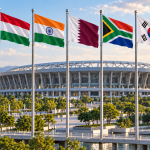
The confirmation of Tokyo, Shanghai, Montreal and Orlando as host cities for the Olympic Q-Series towards Los Angeles 2028 goes far beyond a qualification calendar. The IOC has chosen four strategic stops across Asia and North America for a circuit that will bring together 3×3 basketball, beach volleyball, BMX freestyle, sport climbing, flag football and skateboarding, although the specific programme for each host city will be confirmed at a later stage. The decision takes Olympic qualification to another level: it is no longer just the road to the Games, but is beginning to become part of the Olympic story itself.
For decades, access to the Games depended mainly on the International Federations. Each sport built its own calendar, qualification rules and way of promoting the Olympic pathway. The IOC approved the general principles, but operational and narrative control remained in the hands of each federation. That balance is beginning to change with the Q-Series, which bring sports, host cities and audiences together under a single Olympic brand.
A qualification process with its own brand
The move shows how the IOC is expanding its role within the Olympic cycle. The Games remain the main event, but the road towards them is also beginning to become content, showcase and experience. Qualification is no longer seen as a preliminary phase reserved for each sport, but as a recognisable product, packaged and projected internationally by the IOC itself.
The choice of cities helps explain the intention. Tokyo and Shanghai strengthen the Asian presence in two key markets. Montreal and Orlando place the second part of the circuit in North America, directly ahead of Los Angeles 2028. The map is not based only on sporting criteria. It also speaks to young audiences, commercial visibility, urban sports and the ability to keep Olympic interest alive before the Opening Ceremony.
More visibility, less exclusive control
For the International Federations, the new model offers an obvious opportunity. The Q-Series can give greater visibility to sports that do not normally enjoy sustained global exposure and can turn qualification into a more attractive showcase for athletes, sponsors and media. Disciplines such as skateboarding, sport climbing, BMX freestyle, 3×3 basketball and flag football are especially aligned with the young audiences the IOC has been trying to bring closer to the Olympic Movement for years.
But that exposure also comes with an institutional cost. Qualification has traditionally been one of the major responsibilities of each federation. If the IOC increasingly concentrates the brand, narrative and experience of these events, federations gain a certain level of visibility, but lose part of their exclusive control over how their road to the Games is presented.
A longer Olympic cycle
For National Olympic Committees, the impact may also be significant. Qualification is no longer just a succession of technical events spread across federation calendars. It is beginning to become a series of major international events capable of generating public attention, activating commercial campaigns and giving athletes visibility long before Los Angeles 2028. The Olympic cycle becomes longer and turns into a story that can be told over four years, not only during the two weeks of competition.
That change fits with the direction the IOC has been pushing in recent years: making the Olympic product more continuous, more visible and more connected to new audiences. Commercial sustainability, youth engagement and the global strength of the Olympic brand no longer depend solely on the Games. They are also beginning to be built in the months and years leading up to them.
 Last related articles