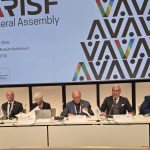
The Executive Board of the Visegrad Four Weightlifting Federation -V4WF- has held its first meeting in Bobrov, Slovakia, since completing the organisation’s registration in the country. Its leaders approved a new logo, agreed to create a dedicated section on the European Weightlifting Federation -EWF- website and decided to begin the process of seeking recognition from the continental federation and, subsequently, the International Weightlifting Federation -IWF-. The meeting took place during the 12th European Union Cup and included representatives of all four members, as well as EWF President Astrit Hasani and Slovak Weightlifting Federation President Tomáš Chovanec.
The new body applies the model of the Visegrad Group to weightlifting. The regional cooperation platform has brought together Czechia, Hungary, Poland and Slovakia since 1991. Its name comes from the Hungarian town where the rulers of Bohemia, Hungary and Poland met in 1335 to strengthen relations between their territories. The four national federations have now used that reference to transform more than a decade of sporting cooperation into a registered organisation with governing bodies and plans to establish its own calendar and budget.
A competition older than the federation
The V4WF is new, but the competition underpinning its project began in 2015. The first Visegrad Four Cup was held in Prague and brought together the national teams of the four countries with support from the EWF and IWF. By 2018, it had reached its fourth edition and included anti-doping education and a presentation on the Tokyo 2020 qualification system alongside the men’s and women’s competitions. The tournament subsequently evolved into the Olympic Hopes format, primarily intended for young athletes and staged on a rotating basis. Its 2026 edition took place in Cheb, Czechia, on 21 and 22 August, with under-18 and under-23 categories, and provided the first competitive reference point following the establishment of the regional federation.
The meeting in Bobrov took place during a separate event. The European Union Cup brought together national teams from 14 countries in the under-15, under-17 and under-20 categories from 17 to 20 September. The Slovak Sports Support Fund contributed €21,500 towards its organisation, while the International Visegrad Fund provided additional support. Chovanec highlighted the work of volunteers, referees and technical staff: “The work of people behind the scenes is an essential part of every major sporting event. Bobrov once again demonstrated that high-quality organisation is the foundation of a successful international competition.” He also addressed the presence of European officials: “It was a great honour for us to host the President of the European Weightlifting Federation. His presence significantly increased the prestige of the event. We also highly appreciate the active participation of representatives of national federations, whose ideas and experience contributed to the further development of both the competition and youth weightlifting. During the four days, we held several working meetings focused on the future of weightlifting in Europe. It is quite rare to see representatives of so many national federations gathered together outside major championship events.”
Recognition, funding and hosting
The next institutional objective will be to obtain formal recognition from the EWF and, at a later stage, from the IWF. Hasani’s attendance, the publication of V4WF activities through European channels and the planned creation of a dedicated section on the EWF website demonstrate an established relationship, but do not mean that the process has already been completed. The regional organisation will not replace its four members either: the federations of Czechia, Hungary, Poland and Slovakia will remain individually affiliated to the EWF and IWF. Recognition is intended to provide an institutional position for the joint platform through which it plans to coordinate competitions, education and professional exchanges.
The Executive Board also began defining the federation’s financial framework by examining operating costs and potential sources of revenue. Its members agreed that hosting responsibilities should rotate among the four countries to distribute the resources required and maintain the involvement of every federation. Poland has been selected to host the 2027 Visegrad Four competition, subject to the necessary approvals. The next meeting will be held in the second half of November, following the World Championships in Ningbo, and will be expected to approve the programme, budget and development priorities for the coming year.
Coaches, officials and new formats
Cooperation will not be limited to staging an annual tournament. The federation wants to share coach education programmes, facilitate exchanges of technical officials and provide more international opportunities for young athletes. Its president, Attila Adamfi, explained that “strengthening regional cooperation is at the heart of the Visegrad Four Weightlifting Federation”. He added: “We want to develop meaningful cooperation at different levels and across different areas of our sport — from coaching education and the exchange of technical officials to creating additional opportunities for young athletes and exploring new competition formats. By combining our experience, expertise and resources, we can contribute to the sustainable development of weightlifting across the region.”
Those possible formats include “urban weightlifting”, although the Executive Board has yet to explain its rules, potential settings or relationship with official competitions. For now, it remains a line of work intended to explore different ways of presenting the discipline rather than an approved event. The V4WF’s progress can be measured through more concrete decisions over the coming months: completing its recognition process, approving a stable funding model, confirming the 2027 competition in Poland and turning cooperation between coaches and officials into programmes with dates and participants. The federation is therefore attempting to transform a youth cup launched in 2015 into a permanent regional structure within European weightlifting.
 Last related articles