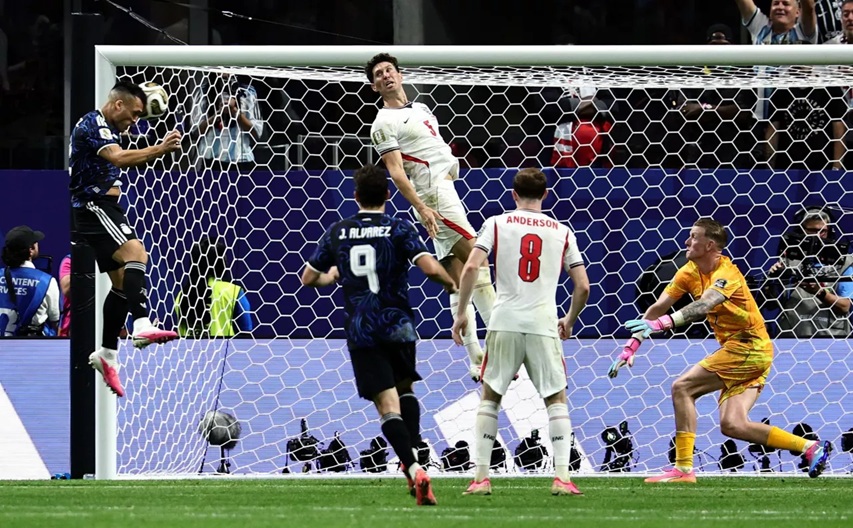
Argentina’s 2-1 victory over England in the World Cup semi-final led Michael Owen to compare the English side’s approach to protecting a lead with that of Spain against France. “Look at Spain when they were 1-0 up last night. That’s courage. That’s bravery. Then look at England with the same 1-0 lead. What’s the difference?” wrote the 2001 Ballon d’Or winner. Owen also questioned Thomas Tuchel’s decision to introduce three defenders before acknowledging Argentina’s superiority: “We are a better team than Argentina, I have no doubt about that. But in the end, we deserved to lose. In fact, it could have been 4-1.”
A day earlier, Thierry Henry had used Spain’s victory to pose a broader question: “Who are you? What is your philosophy? What is your identity?” The former French international traced Spain’s success to a structure that begins long before players reach the senior national team, allowing each newcomer to understand the system because they have been playing within it since the age of nine. “They have an identity, a philosophy, they all play the same way at every level,” he said after Spain reached the final.
The semi-final illustrated the value a football identity can acquire when it is maintained across several generations. Spain’s model became particularly visible from 2008, during the cycle that delivered two European Championships and a World Cup, but it has not remained static: different profiles, rhythms and solutions have been incorporated without abandoning its technical and possession-based foundations. Argentina’s identity probably stretches back much further and represents a passion passed down from one generation to the next. That continuity gives youth academies, development teams, coaches and a domestic league whose leading talent systems share much of the same language a central role. Other national teams, by contrast, have repeatedly replaced their principles, attempted to copy more recent models or continued searching for a balance between their traditions and the demands of the modern game.
Luis de la Fuente adds human continuity to Spain’s structure. Before taking charge of the senior side, he spent almost a decade coaching the Under-19, Under-21 and Olympic teams, working with Rodri, Mikel Merino, Mikel Oyarzabal, Dani Olmo, Fabián Ruiz and Unai Simón. “Some time ago, we began to emphasise a word that gave us a great deal of security, confidence and strength — ‘family’. We want the Spanish national team to be a family,” he told ‘Reuters’. In an interview with Sid Lowe for ‘The Guardian’, De la Fuente also recalled how Spain matches became family occasions at his home in Haro, where his parents, siblings and other visitors would gather to watch the team.
Argentina turns the ‘pibe’ into a national identity
Argentina’s identity stems from a cultural construction that predates its major titles. During the 1920s, sports journalists promoted a style intended to distinguish the country from the physical and methodical football introduced by the British. The central character was the ‘pibe’: small, streetwise, creative, rebellious and cunning. In 1928, Borocotó imagined a statue of the Argentine footballer in ‘El Gráfico’ as a young man of humble origins, with dark hair, worn teeth and a roguish smile. The description was written 32 years before Diego Maradona was born, but ultimately resembled the figure who would later embody much of that tradition.
Jorge Valdano connected that competitive knowledge to the team’s response after France equalised in the Qatar final: “Argentine culture carried us through the World Cup final in Qatar. Our know-how and cunning allowed us to triumph in a match when France had managed to level it. And that’s something you learn in the street.” From Maradona to the psychological games of Emiliano Martínez, the ‘pibe’ operates less as a tactical system than as a cultural way of understanding competition. The comeback against England again demonstrated that ability to withstand an adverse situation and change the course of a match without abandoning its competitive character.
Germany loses its pattern as Brazil tries to rebuild
Philipp Lahm returned to the same idea after Germany’s third consecutive early World Cup elimination. The former captain attributed the decline to a decade of constant changes to players, positions, hierarchies and systems. Germany was known for years as a ‘Turniermannschaft’, a team capable of growing into major tournaments, but Lahm believes that quality has faded. “Are we Spain? Are we Argentina? Are we France? No, we are Germany. We have our own culture, our own brand of football. We should reconnect with our identity,” he wrote.
Brazil entered the World Cup undergoing a different kind of reconstruction. Carlo Ancelotti used Carnival to describe the team he wanted to build: joy, creativity and energy supported by preparation, commitment and collective organisation. “What Brazilian players and Brazilian football must not lose is their greatest quality: creativity, joy and energy,” he told ‘Reuters’. His proposal was not to reproduce a nostalgic version of ‘jogo bonito’, but to adapt that spontaneity to a game with greater tactical intensity. Brazil’s earlier-than-expected elimination meant that a model still searching for definition did not immediately translate into results.
Japan turns football identity into a national plan
Japan has followed an institutional route to define the football it wants to represent. The Japan Football Association -JFA- approved the ‘Japan’s Way’ philosophy in 2022 and published its second version in December 2025. The document connects four areas: national teams, player development, coach education and grassroots football. It also establishes a playing vision, the characteristics of the ideal Japanese footballer and the principles that should guide players from the earliest age groups.
The plan covers both international performance and the sport’s social reach. The JFA wants national teams, academies and coaching programmes to work with shared terminology, supported by review mechanisms that allow the model to adapt as football evolves. ‘Japan’s Way’ sets two objectives for 2050: for Japan to win a World Cup and for its football community to reach ten million people.
 Last related articles