FIFA recorded revenues of $7.5 billion in the four-year commercial cycle leading up to the 2022 Qatar World Cup, setting a new record more than $1 billion higher than the previous cycle linked to Russia 2018, demonstrating that public criticism does not necessarily translate into financial damage.
This raises an important question. Why has FIFA been able to absorb reputational pressure so effectively while the International Olympic Committee appears more exposed?
The answer lies in strategy. After the corruption crisis of 2015, FIFA moved quickly to reshape its sponsorship model. When traditional partners such as Sony and Emirates stepped away, they were replaced by major Chinese corporations like Wanda and Vivo, along with state-backed companies from the Middle East including Saudi Aramco and Qatar Airways.
These partnerships are not driven purely by commercial return. For state-linked sponsors, global visibility and geopolitical influence often outweigh profitability. Sponsorship becomes an instrument of soft power. In return, FIFA offers hosting rights and worldwide exposure while placing human rights concerns lower on its list of priorities.
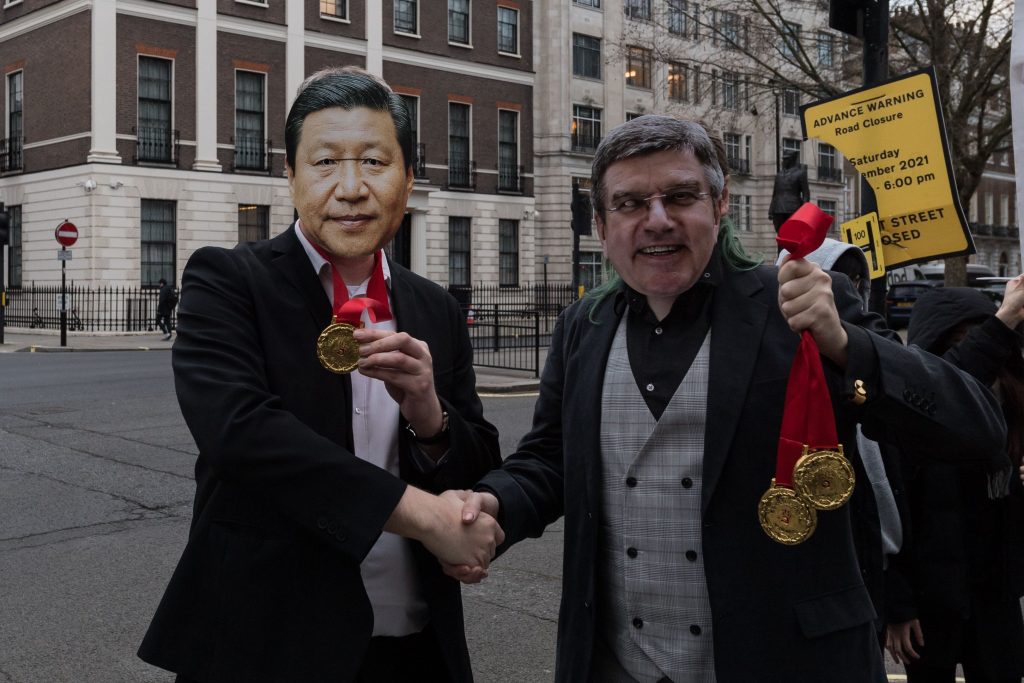
Protest against Beijing 2022 – Chinese Embassy In London
The Olympic model is different
The IOC’s TOP programme depends heavily on multinational corporations such as Coca-Cola, Visa, Toyota, Samsung and Intel. These companies operate in consumer-driven markets where brand image, reputational sensitivity and public trust directly affect performance.
Toyota’s decision not to renew its long-standing TOP partnership after Paris 2024 illustrates the sensitivity of Olympic sponsorship to reputational considerations. The company cited concerns including the growing complexity surrounding the Olympic environment and the evolving relationship between the IOC and athletes.
This context helps explain the IOC’s growing engagement with China.
IOC President Kirsty Coventry, alongside senior Olympic leadership, recently travelled to Beijing and Guangzhou to meet Chinese officials including President Xi Jinping. The visit underlined a broader strategic direction and a potential diversification of partnerships.
From the IOC’s institutional perspective, China offers a highly predictable operating environment, long-term infrastructure planning and strong governmental support for major sporting events. These characteristics provide organisational certainty for projects that require long-term planning and significant public investment.
China also represents unmatched scale. A major initiative launched in cooperation with the China Institute of Sport Science aims to engage up to 100 million people through community-based and digital sport participation programmes by 2028.
For the Olympic Movement, this extends beyond grassroots development. It represents access to one of the largest potential audiences in the world at a time when youth engagement and traditional sports viewership in several Western markets are facing structural pressure and long-term decline.
Coventry described China as a strong and reliable partner. The political value of that relationship is clear. It offers stability and reach, but it also raises deeper questions.
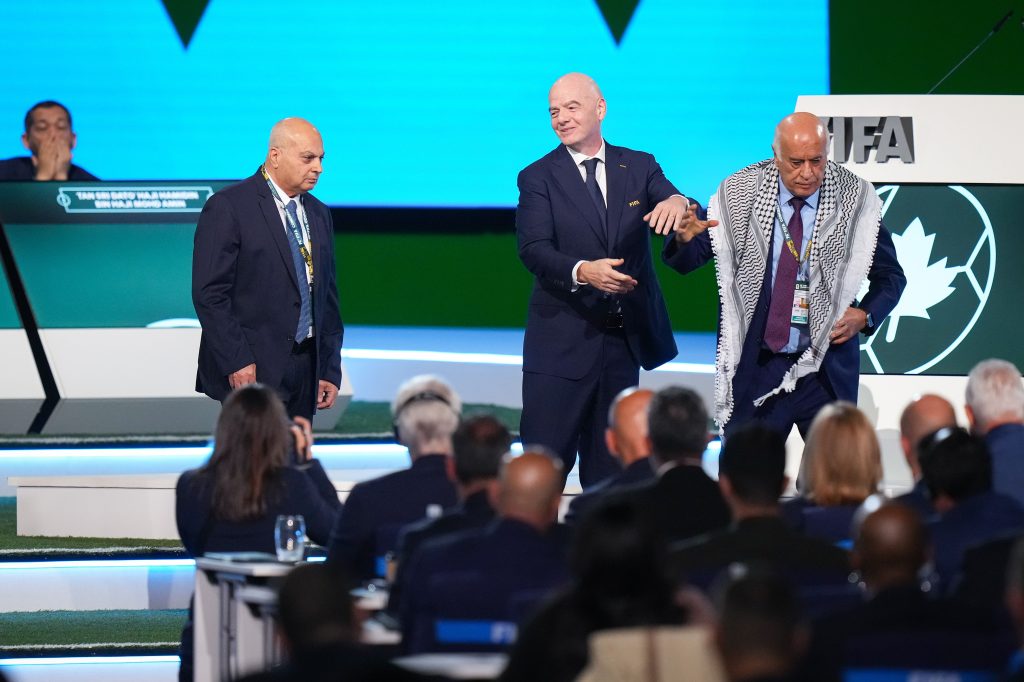
The 76th FIFA Congress, in Vancouver, 2026
But this stability comes at a cost
At its 146th Session in Lausanne, the IOC approved significant changes to the Olympic Charter as part of its Fit for the Future strategy. The reforms reinforce the principle of neutrality and introduce more flexibility in shaping the Olympic programme based on global appeal and cost.
The emphasis on neutrality is intended to shield sport from external interference. Some governments, human rights organisations and governance observers argue that this approach risks producing the opposite effect. By avoiding clear positions on global conflicts and human rights issues, the IOC may be engaging in a form of political positioning that indirectly favours certain actors.
This is where the real weakness lies
The challenge is no longer simply about maintaining neutrality. An increasingly debated governance question is whether neutrality can continue to function as originally conceived in a geopolitical environment where sport, diplomacy and global influence are becoming progressively intertwined.
Whether the IOC ultimately succeeds in maintaining that balance remains uncertain. What appears increasingly evident, however, is that future Olympic governance will be judged not only by sporting success, but by the institution’s ability to reconcile commercial sustainability, geopolitical complexity and public legitimacy within a rapidly changing international environment.
 Last related articles