The Milano Cortina 2026 Paralympic Winter Games, taking place from 6 to 15 March, will once again spotlight one of elite sport’s most unique partnerships: the bond between skiers with vision impairment and their guides. In events such as Para alpine skiing, Para biathlon and Para cross-country skiing, athlete and guide compete as a single unit, communicating through helmet-mounted systems as they race downhill at speeds approaching 100 kilometres per hour.
In that setting, Canadians Kalle Eriksson and Sierra Smith will make their Paralympic debut, putting four years of shared work to the test. Eriksson, 21, began losing his sight in 2021; Smith, 25, stepped away from her solo racing career after several knee injuries. “From day one skiing together, it worked really well. We had immediate trust in one another. It’s the name of the game in what we are doing,” she says. He sums up the dynamic simply: “I trust a lot in her to get me down fast and safely.”
Skiing as one
During competition, the guide skis ahead and relays every detail of the course through a Bluetooth system integrated into the helmet. “I am Kalle’s eyes on the course. He can see a bit; he has six per cent peripheral vision… I’m communicating with him the entire time we are going down. Not so much left and right, but terrain changes or anything interesting coming up in the course,” Smith explains. The bright pink of her race suit is deliberate — it is the colour Eriksson can distinguish most clearly.
In Italy, the partnership between Giacomo Bertagnolli and his guide Andrea Ravelli offers another example of that precise coordination. Born on the same day, 18 January, seven years apart, they maintain constant communication on the slopes. “When we ski, we speak. I tell him right, left, jump, go faster, you can push!” Ravelli says. For the guide, the demands are not only technical and physical but emotional as well: “The most beautiful thing is sharing victories, but there are many defeats and tough moments. When you overcome problems together and achieve the result, that’s the best part.”
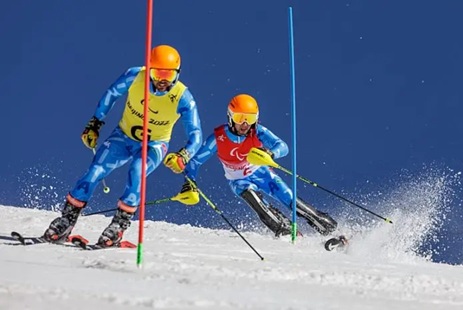
Constant communication at high speed
In Para cross-country skiing and Para biathlon, synchronisation is equally decisive. Finland’s Inkki Inola and his guide Arttu Kaario work to maintain a short, consistent distance throughout the race. “The closer the better. If it’s more than three metres, it’s too much,” Kaario says. Inola highlights the importance of shared rhythm: “It’s important for the guide to be on top of the situation. Our rhythm has to be similar.” During these events, spectators are asked to remain quiet so athletes can hear their guides’ instructions clearly.
Eriksson and Smith, who spend much of the year 3,500 kilometres apart — he lives in Kimberley, British Columbia — combine solo training with joint camps on snow. The Canadian skier has developed strategies to manage nerves and follows pre-race rituals. “I always put my right side on first: right ski, right boot, right glove,” he says. A shoulder injury in October required adjustments to their preparation, but in December they returned to the podium with two silvers in St Moritz before adding another medal in Santa Caterina.
More than technique: trust and shared experience
The athlete-guide relationship is built not only on snow but off it. During training camps, they prioritise activities beyond skiing — mountain biking, rock climbing or even line dancing — to strengthen their rapport. “It’s been a huge transition going from my solo career to having a teammate. It’s made me rediscover my love for the sport. I’m very thankful I get to ski every day with Kalle and enjoy this crazy ride,” Smith says.
At Tofane Alpine Skiing Centre in Milano Cortina, pairs will race connected by voice, rhythm and trust. At the start gate, two athletes share one objective and one result: crossing the finish line as if they were a single skier.
 Last related articles